
Your Pool Pump Is Costing You More Than You Think
A high efficiency pool pump is the single smartest upgrade you can make for your backyard pool — cutting energy bills by up to 90% compared to old single-speed models.
Quick answer: Top high efficiency pool pumps for 2026
| Pump Model | Type | Best For |
|---|---|---|
| Hayward MaxFlo XE 2.25HP | Multi-speed | Affordable efficiency upgrade |
| Hayward TriStar VS | Variable speed | Maximum energy savings |
| Hayward Super Pump 0.85HP | Single-speed (high efficiency) | Entry-level replacement |
| Hayward MaxFlo XL 0.75HP | Single-speed (high efficiency) | Smaller residential pools |
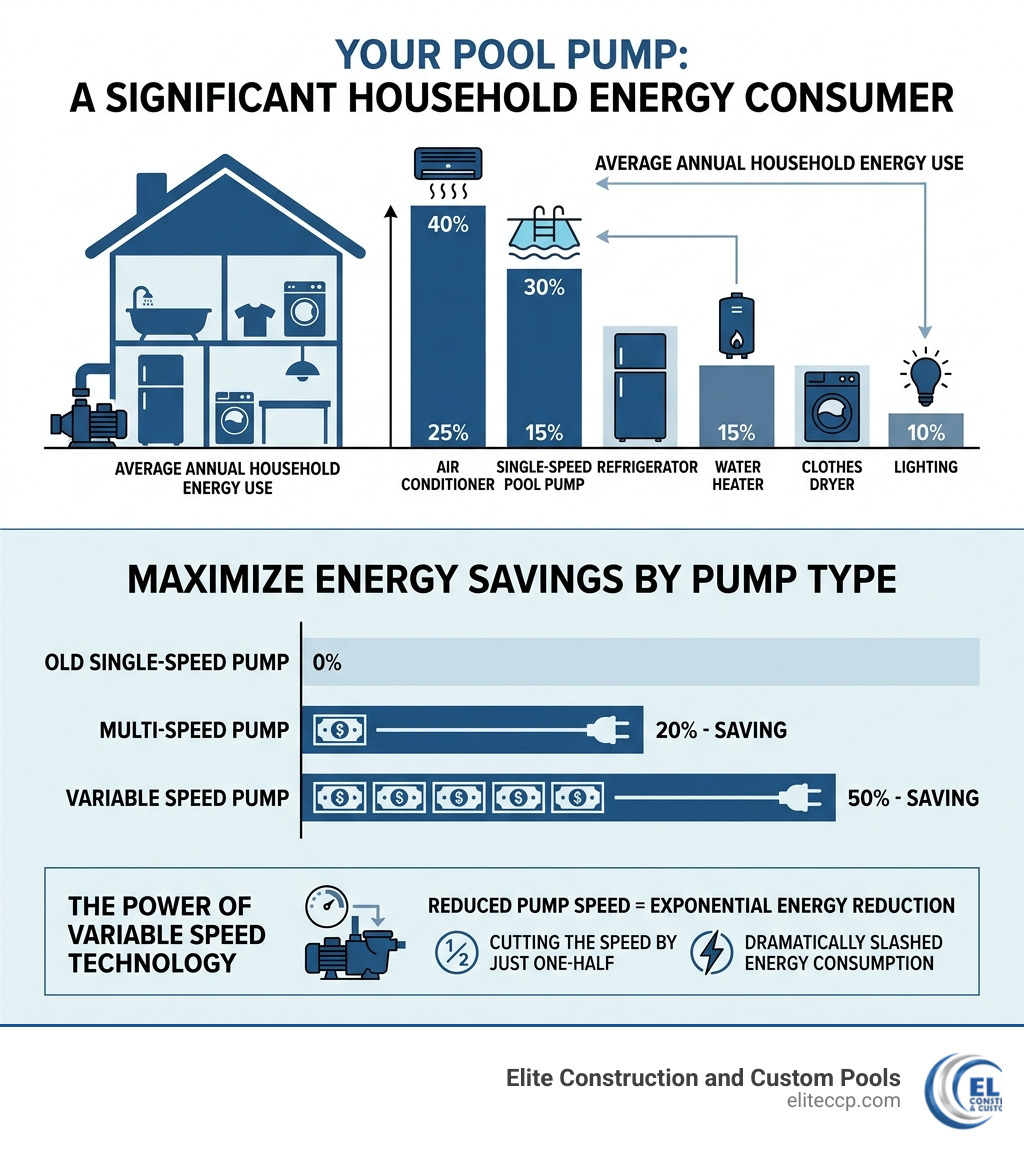
Pool pumps are typically the second largest energy user in a home — right behind your air conditioner. For Texas homeowners, that’s a serious hit to your utility bill, often running up to $310 per year just to keep the water circulating. Upgrading to a high efficiency model can flip that equation fast, with some variable speed pumps paying for themselves in as little as one to two years.
I’m Chris Koester, founder of Elite Construction & Custom Pools, and through years of designing and building custom pools across Texas, I’ve specified and overseen the installation of countless high efficiency pool pump systems that dramatically reduce operating costs for homeowners. That hands-on experience across hundreds of builds is what shapes every recommendation in this guide.
Why Every Owner Needs a high efficiency pool pump
If you are still using a traditional single-speed pump, you are essentially driving a car that only has one setting: “pedal to the metal.” Whether you are simply filtering the water or trying to power a massive rock waterfall, a single-speed pump blasts away at maximum RPMs, wasting a staggering amount of electricity.
A high efficiency pool pump changes the game by utilizing variable speed technology. Instead of one speed, these pumps use permanent magnet motors (similar to those found in electric cars) that allow you to dial in the exact flow rate needed for the task at hand. According to the Department of Energy, reducing a pump’s speed by just one-half actually reduces the energy it consumes to just one-eighth of the original amount. This is due to the cubic relationship between speed and power, and it is the secret sauce behind the massive savings we see in Waller and Houston area backyards.
When shopping for an upgrade, we always look for three key certifications:
- ENERGY STAR Certification: This indicates the pump has been third-party tested to meet strict efficiency guidelines. These pumps can save you over $300 over their lifetime compared to non-certified models.
- WEF Ratings: The Weighted Energy Factor (WEF) is like the “MPG” for your pool. The higher the WEF number, the more efficient the pump is at moving water per watt of electricity.
- DOE Compliance: As of 2021, new federal regulations require most residential pumps to meet higher efficiency standards.
Beyond the checkbook, these pumps offer incredible lifestyle benefits. They utilize Totally Enclosed Fan-Cooled (TEFC) motors, which run much cooler and quieter than old-school motors. In fact, many high-efficiency pumps are four times quieter than single-speed models—often operating at noise levels below 45 decibels. That’s the difference between a loud vacuum cleaner and a soft whisper. Plus, because they run at lower speeds, there is less strain on your pool equipment, leading to a significantly longer lifespan for your plumbing and filter.
Top Hayward high efficiency pool pump Models for 2026
When we design custom pools in places like Cypress or The Woodlands, we frequently turn to Hayward’s lineup because of their reliability and cutting-edge tech. Here are the standout models for the coming year:
- MaxFlo XE: This is the “sweet spot” for many homeowners. The MaxFlo® XE Ultra-High Efficiency Pump, 2.25HP offers a multi-speed solution that is significantly more affordable than a full variable-speed pump while still blowing traditional pumps out of the water in terms of efficiency. It features dual-voltage capability, making it an easy drop-in replacement for almost any existing setup.
- TriStar VS: This is the heavyweight champion of energy savings. The TriStar VS is often cited as the most energy-efficient pump on the market, capable of saving homeowners up to $1,500 annually on utility bills. It is perfect for larger pools with complex water features.
- Super Pump High Efficiency: A legend in the industry, the Super Pump High Efficiency Pump, 0.85HP is the go-to for standard pool replacements. It’s dependable, proven, and now meets all modern DOE efficiency standards. If you need a reliable pool equipment repair in Waller TX, this is often the model we recommend for a seamless upgrade.
- MaxFlo XL: Ideal for entry-level applications, the MaxFlo XL provides advanced hydraulics and a heavy-duty motor. It’s a great way to get high-efficiency performance without a high-end price tag.
Key Features of Modern Hayward Pumps
What makes these modern Hayward pumps so much better than the ones from ten years ago? It comes down to the engineering. Modern pumps feature NEMA Premium motors, which are designed for cooler operation and maximum electrical-to-mechanical energy conversion.
We also love the user-friendly touches that make pool maintenance and repair much simpler for the homeowner:
- See-Through Strainer Covers: No more guessing if the basket is full. You can see exactly when it’s time to empty the leaves.
- Swing-Away Hand Knobs: Hayward’s exclusive design allows you to remove the strainer cover without any tools or loose parts to lose in the grass.
- Smart Home Integration: Many of these models can be controlled directly from your smartphone, allowing you to adjust speeds or set schedules from your patio or even while you’re away on vacation.
- Modular Plumbing: With standard union connections and a shorter overall length, these pumps are designed to fit into tight equipment pads, making the installation process much cleaner.
Maximizing ROI with Variable Speed Technology
Upgrading to a high efficiency pool pump isn’t just an expense; it’s an investment that pays dividends every month. In the Texas heat, where pools run for long hours to keep algae at bay, the electricity savings are dramatic.
While a traditional pump might cost you $300 to $600 per year to operate, a variable speed pump can do the same job for a fraction of that. By running the pump longer at a much lower speed, you achieve better filtration (because water moves through the filter slower, catching more debris) while using 90% less energy.
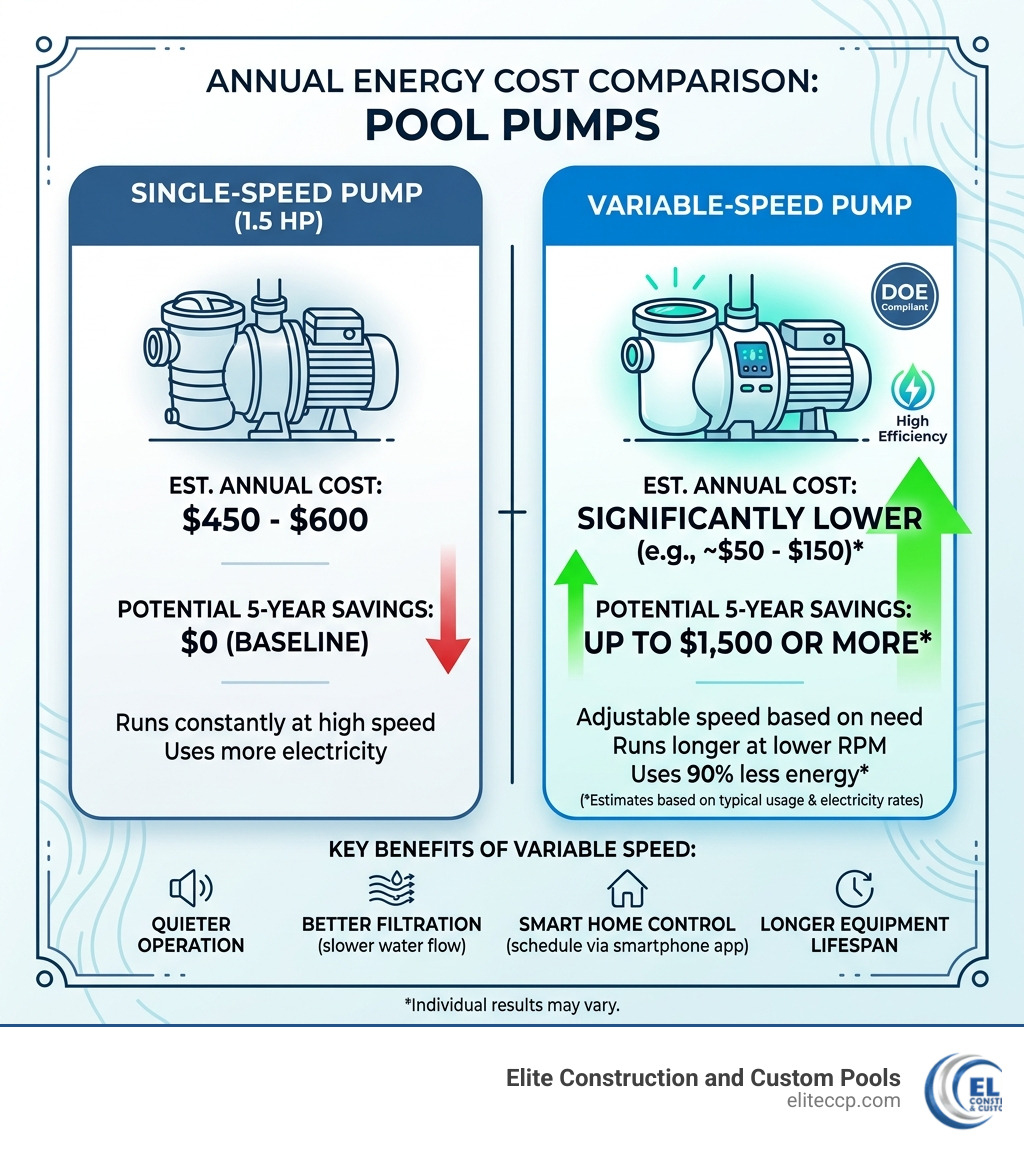
Annual Energy Cost Comparison (Estimated for 20,000 Gallon Pool)
| Pump Type | Est. Annual Cost | Potential 5-Year Savings |
|---|---|---|
| Single-Speed (1.5 HP) | $450 – $600 | $0 (Baseline) |
| High Efficiency Single-Speed | $350 – $420 | $500 – $900 |
| Variable Speed (VS) | $50 – $120 | $2,000 – $2,400 |
The “payback period”—the time it takes for the energy savings to cover the cost of the pump—is typically between 12 and 24 months. After that, the money stays in your pocket. Furthermore, many utility companies in the Houston area offer rebates for installing ENERGY STAR certified equipment, which can shave even more off your initial cost. Reducing your energy consumption also lowers your home’s carbon footprint, making your backyard a little greener in more ways than one. For more details on how to manage these costs, check out our pool maintenance repair guide in Waller Houston TX.
Installation and Maintenance Best Practices
To get the most out of your new pump, proper installation is non-negotiable. At Elite Construction & Custom Pools, we focus on minimizing “hydraulic resistance.” This means using larger diameter pipes where possible and ensuring the plumbing layout is as straight as possible. The harder the pump has to “push” against the plumbing, the more energy it uses.
Once installed, maintenance is the key to longevity. A clogged basket or a dirty filter makes the pump work harder, increasing energy draw. We recommend:
- Regular Basket Cleaning: Empty the pump and skimmer baskets at least once a week.
- Filter Backwashing: Keep your filter clean to ensure maximum flow.
- Off-Peak Scheduling: If your utility provider offers lower rates at night, program your pump to do its heavy lifting (like running the cleaner) during those hours.
- Seasonal Adjustments: You don’t need the same turnover in January as you do in the middle of a July heatwave. Adjust your run times seasonally to save even more.
If you ever run into issues like leaks or strange noises, it’s important to seek swimming pool pump repair immediately. A small air leak in the suction line can cause the pump to lose prime, which can overheat the motor and void your warranty.
How to Size Your high efficiency pool pump Correctly
One of the biggest mistakes we see is “over-pumping.” Many homeowners think a bigger motor is always better, but a pump that is too powerful for your plumbing can actually damage your filter or heater.
To size a pump correctly, you must calculate:
- Pool Volume: Total gallons of water.
- Turnover Rate: The time it takes to circulate the entire volume of the pool. For residential pools, we aim for at least one full turnover every 24 hours, though 6 to 10 hours is a common goal for optimal clarity.
- Flow Rate (GPM): How many gallons per minute the pump needs to move to achieve that turnover.
- Total Dynamic Head (TDH): The total resistance the pump must overcome (pipe length, height, and fittings).
While we don’t have the same strict Title 20 mandates as California here in Texas, following those efficiency principles is still the best way to save money. If you need help with the math, our team provides weekly pool cleaning in Waller TX and can help evaluate if your current pump is the right fit for your pool’s specific hydraulics.
Frequently Asked Questions about Pool Efficiency
How much money can I save annually with a high-efficiency pump?
In the Texas market, most homeowners see a reduction of $300 to $900 per year on their electricity bills after switching from a single-speed to a high-efficiency variable speed pump. If you have a large pool with multiple water features, those savings can climb even higher, sometimes exceeding $1,100 annually.
Do I need a special pump for a saltwater pool system?
No. High-efficiency pumps from brands like Hayward are fully compatible with both traditional chlorine and saltwater systems. The “saltwater” part of the equation is handled by your salt chlorine generator cell, not the pump itself. However, the improved circulation from a variable speed pump often helps salt systems work more effectively by providing a steady, low-speed flow.
How does a variable speed pump reduce noise levels?
Noise in a pool pump comes from two places: the motor and the water turbulence. Because variable speed pumps use permanent magnet motors (which are naturally quieter) and run at lower RPMs, the mechanical noise is drastically reduced. Furthermore, moving water more slowly through the pipes reduces the “whooshing” sound of hydraulic turbulence.
Ready to Cut Energy Waste and Upgrade Your Pool?
Upgrading to a high efficiency pool pump is truly a “no-brainer” for any pool owner in the Waller or Houston area. Between the massive energy savings, the whisper-quiet operation, and the improved water clarity, the benefits are immediate.
At Elite Construction and Custom Pools, we don’t just build pools; we build efficient, state-of-the-art outdoor retreats. Whether you are in Magnolia, Cypress, or Katy, we use premium materials and meticulous detail to ensure your pool is as easy to maintain as it is beautiful to look at. From our state-of-the-art 3D designs to our expert equipment installations, we are here to help you dive into a more efficient lifestyle.
Ready to upgrade your backyard? Explore our pool equipment services today and let us help you start saving.